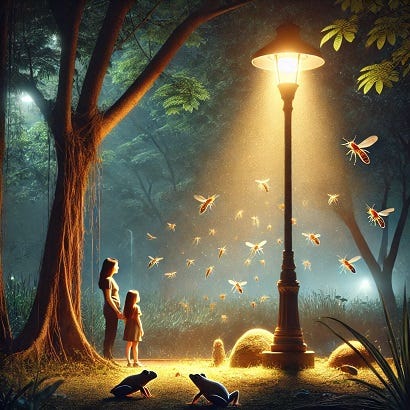
Anjali and her mother often went to the nearby park to spend time in nature. The park had a wide variety of trees, flowering plants, insects, and birds. Both enjoyed their time there. One day, while walking back home from the park, Anjali noticed a large group of insects flying around a street light.
 |
| Amma, why are those insects flying near the street light?, asked Anjali |
"Amma, why are those insects flying near the street light?" Anjali asked, tilting her head.
"They are swarming termites," her mother explained. "They're attracted to the light and are looking for a place to establish a new colony where food is available. They usually come out after it rains."
After watching the insects for a while, Anjali looked down at the base of the lamp post. Her eyes widened as she noticed frogs hopping around, catching the flying insects with their sticky tongues. "Amma, look! The frogs are eating the termites. That is so sad! The termites just want to find a new home, and now the frogs are eating them! Maybe we should move the frogs away." She took a step forward, as if about to help the insects escape.
Her mother gently held her back, smiling. "I know what you are feeling, dear. It's so kind of you to feel sorry for the termites, but the frogs are hungry too. They need to eat, just like you and I do to gain energy."
Anjali frowned. "But why do they have to eat the termites? They're just looking for a new home. Can't they eat something else? It's not fair." Her eyes slowly filling with tears as she glanced between the frogs and the insects.
Amma knelt down next to her and said, "Let me explain how nature works, Anjali. Every living being has to eat to survive and this creates something called a 'food chain.'"
Anjali's curiosity took over her sadness. "Food chain? What's that, Amma? I've never heard of it before", Anjali asked curiously.
"The food chain is about who eats whom. All living beings need energy to survive, so everyone has to eat. I eat food, you eat food and even termites and frogs need to eat," Amma explained with a soft smile.
Anjali thought for a moment and said, "Yeah, I eat fruits, chapatis and rice."
"Exactly! So, where do fruits come from?" Amma asked.
"Trees," Anjali answered confidently.
"You are right! Trees use water from the soil and energy from the Sun to produce food. So in a way, when you eat apples, you're eating sunshine" Amma said, tapping Anjali's nose playfully.
Anjali giggled.
Anjali's eyes widened. "So the frog needs to eat the termites to live?"
"Yes, just like you need to eat food to grow big and strong, the frogs need to eat termites to hop, catch more insects, and grow bigger," Amma said, her tone gentle and reassuring.
"But why couldn't the termites fly away? They seemed so helpless!" Anjali asked, still feeling sadness for the termites.
"Frogs are great hunters," Amma explained. "They have long, sticky tongues that they shoot out really fast. And sometimes, the termites are just too slow to escape."
"Ohh…" Anjali exclaimed.
"That is how nature works," Amma said, gently stroking Anjali's head.
After thinking for a while, Anjali asked, "So, the termites eats something and the frog eats the termite. Does that mean the frog will be eaten by someone too?"
"You are absolutely right," Amma said proudly. "The food chain works just like that. It is a big cycle where every living being depends on another for survival.
Seeing Anjali's interest, Amma continued, "For example, grasshoppers eat plants, frogs eat grasshoppers, snakes eat frogs, and eagles eat snakes and when an eagle dies, small insects and ants feast on it. The remains of the eagle decompose and become nutrients for plants to grow. Isn't that amazing?"
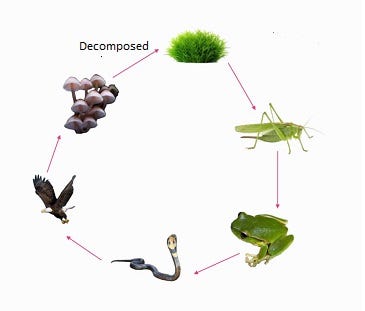 |
| The food chain |
"Mm," said Anjali, her brow wrinkled in thought. After a few moments of silence, she asked, "Are we part of the food chain too? Will someone eat us?" worry crept into her voice.
Amma chuckled softly. "Some big animals, like lions and tigers can eat humans in the wild. But we don't live in the forest, so there's nothing to worry about," she said, trying to ease Anjali's fears.
Amma continued, "Long ago, when humans lived in the wild, we were part of that cycle. lion, tigers and other wild animals could eat us. So humans had to find ways to protect themselves." Amma paused, looking at Anjali's worried expression.
"And now?" Anjali pressed.
"Now we have built cities and learned to protect ourselves. We grow our own food, so we are at the top of the food chain now." Amma smiled reassuringly.
"So, we broke the food chain?", asked Anjali.
"We haven't broken it completely, but humans have changed it by growing our own food and building cities where animals can't easily reach us."
Anjali felt a bit better, but her curiosity hadn't been satisfied yet. "We are vegetarians, so we don't eat other animals. But why can't every animal just eat plants and fruits to keep other animals safe?"
Amma smiled at her thoughtful question. "That is a wonderful idea, but every animal has its own digestive system and special way of eating. Some animals are designed to eat plants, while others, like frogs, eat insects because that's how they stay strong. For example, ladybugs commonly eat green flies, but if those aren't available, they will eat soft-bodied worms instead.
Anjali nodded her head.
"To keep balance in nature, we have a food chain. It ensures that every animal gets the food it needs to survive," Amma added.
"Balance? What do you mean by balance, Amma?"
"Imagine this: if the frogs didn't eat termites, they would get weak and die. Then, the snakes that eat frogs wouldn't have enough food, and so on. Everything in nature is connected, and if one part of the chain is broken, it affects the whole cycle," Amma explained.
"So, the food chain is necessary, but we don't have to worry about someone eating us, right?" Anjali asked, her brows finally relaxing.
Amma smiled and said, "Yes, we don't need to worry"
"It also means that all living beings are equally important in the food chain to keep it intact."
"Yes, Anjali. They are all equally important. You are doing a great job understanding how the world works and asking such thoughtful questions." smiled Amma.
Anjali watched the frog eating termites with her new found understanding and said, "I am no longer frightened to see a frog eat a termite."
"It's so nice to hear that you're not scared any more. When we learn how nature works, we don't have to be afraid. Understanding things can make them feel less scary, right?" said Amma.
As they left for home, Amma and Anjali felt a sense of understanding.
Comments
Post a Comment